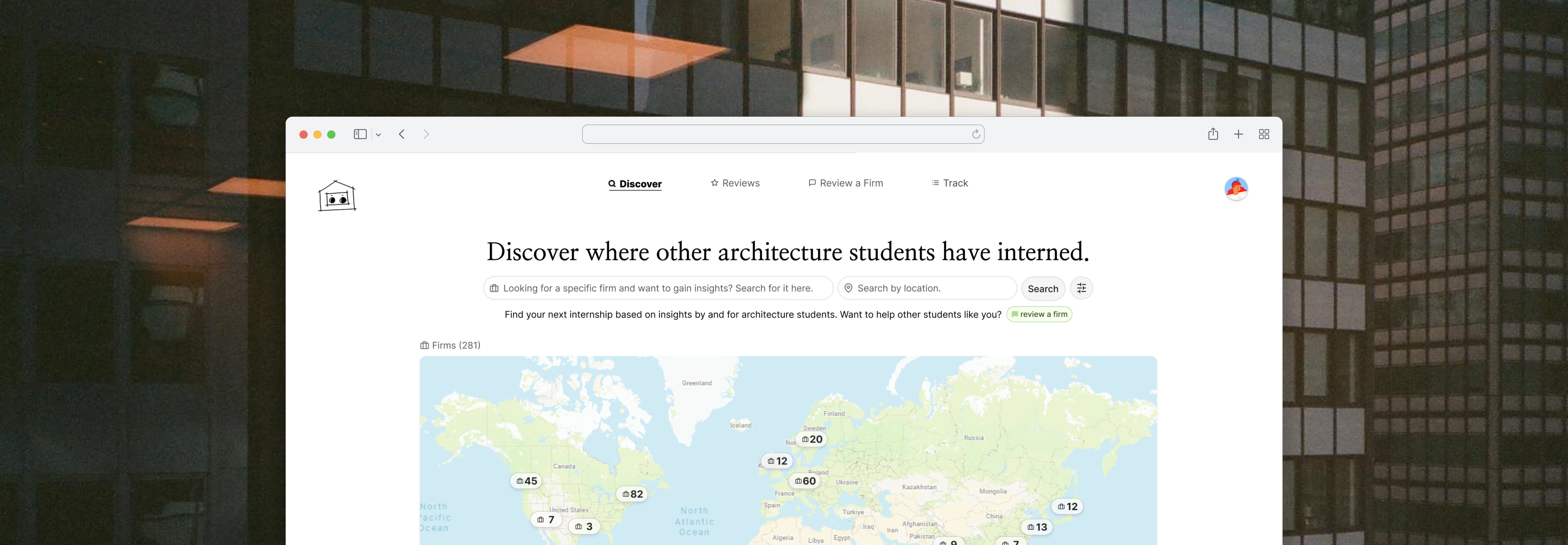
Architecture Internship Finder is a collaborative platform by and for architecture students to share information about their past internship experiences and find firms to apply to based off of the collected and shared knowledge.
This started as a passion project born out of my frustrationsfrom applying to architecture internships.
PERSONAL CONNECTION
I had to search for six architecture internships in my undergraduate degree!
Since I was in an architecture co-op program for my undergrad, I had to search for and apply to many many architecturefirms in order to complete these co-op terms. I truly treasured all of my internship experiences, but the process was hard!
Photos from past internships in Copenhagen and New York City!⋆˚꩜。 ↓
The best ways to find firms were shared through links and word of mouth. There had to be a better way! . ݁˖ .⋆
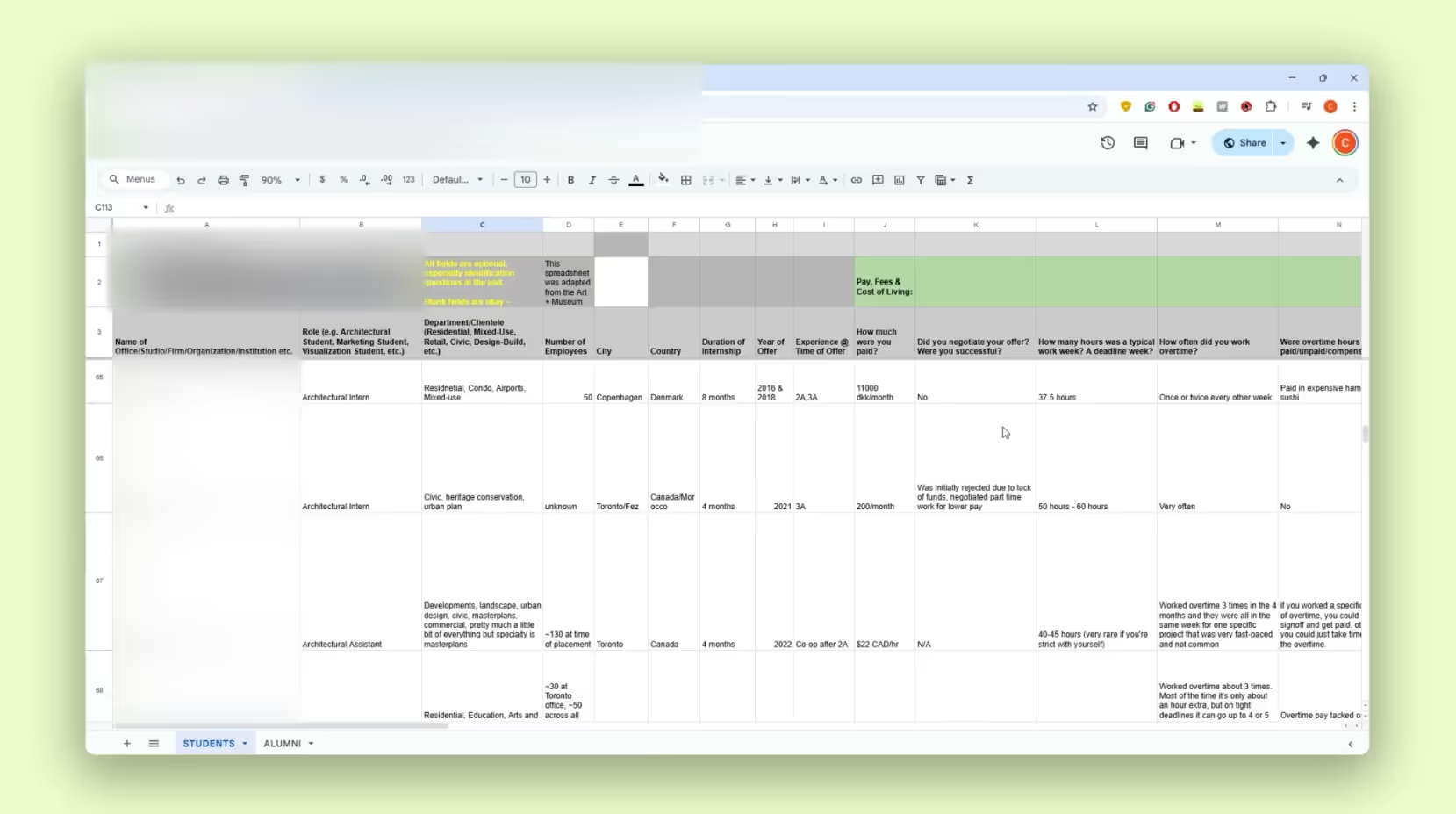
While typical job platforms existed, like my school's and firm's application portals, my most reliable tools for finding firms and information about them were shared Google Sheets and word of mouth.
If I didn't know people, it was easy to miss out on opportunities!
A Google Sheet shared between students at my undergraduate university. (**Sensitive information redacted.**)
PROBLEM STATEMENT
Architecture students need a way to find firms they can intern at and insights into these firms in order to gain meaningful internship experiences.
SOLUTION
An architecture-centered, user-driven platform that allows students to discover firms to work for based on other students' experiences.
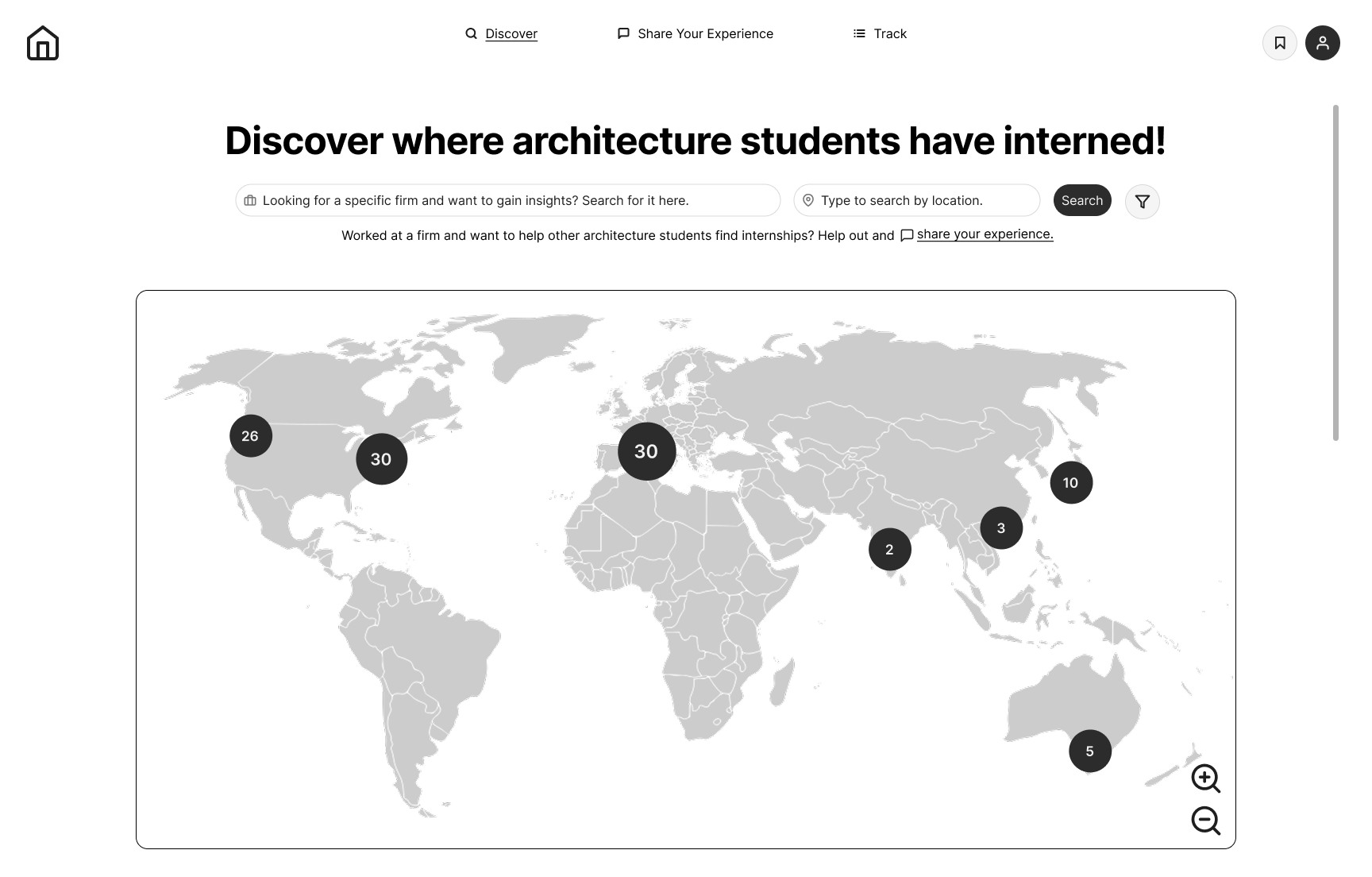
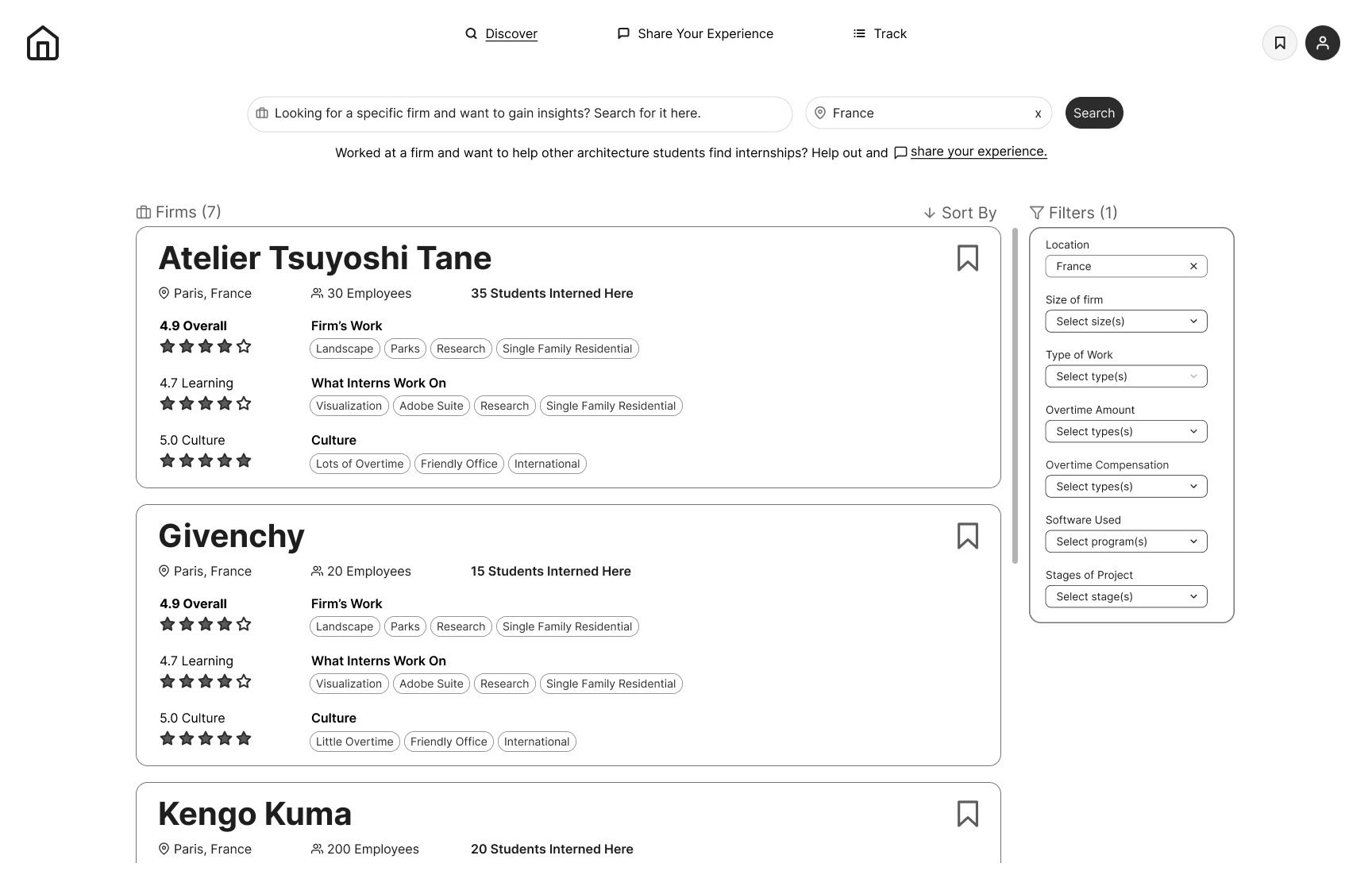
Map-first interface
Internships allow architecture students to try living in new places and learn about architecture, landscape design, and urban planning through physically being in new environments. From user interviews, the location of an internship was consistently highlighted as the most important criterion when searching for firms to apply for.
Robust filtering system
As students gain internship experience, they have varying internship wants and needs. The specific filters, based off criteria received from student feedback, allow students to find firms that best fit the exact criteria that they are looking for.
Here is how I got to the solution...
COMPARATIVE ANALYSES
What are gaps in current solutions?
I evaluated Google Sheets, Waterloo Works (my university's job application platform), Glassdoor, and Canary and found that existing tools were either hard to gain access to or did not meet architecture-specific needs.
Google Sheets
Easy to collaborate and share
Can capture lots of information
Users can edit each other cells
Overwhelming at a glance
Link needs to be shared by people
School Platform
Easy and smooth application process
No ghosting; guarantted responses
Limited amount of options domestically and internationally
Glassdoor
Robust review system
Users have to leave a review to use it
Not geared towards students concerns
Mainly larger companies
Canary
Robust review system
Internship specific reviews & concerns
Catered to engineering and computer science roles
USER INTERVIEWS
I conducted 5 interviews with architecture students who had completed architecture co-op undergraduate programs.
I wanted to know how the students found offices that they wanted to work for, what criteria they were looking for when searching and selecting firms to work for, and how the application process went for them.
“...because you're putting in so many applications...you can't extensively look into every firm that you might be applying to.” - Interviewee P01
“...when it came to looking abroad, it was scary because you end up cold emailing and you have very little knowledge of the place you're applying...You kind of feel like you're on your own..." - Interviewee P04
“...[I] wanted to move to a given place and then found jobs based off of the location. The desire for the location preceded the job and not the other way around.” -Interviewee P05
INSIGHTS & PAIN POINTS
Finding and getting a desired internship is hard!
Location is key
Internships let students explore living in new places that they wouldn't normally have access to.
School platforms are limited
School portals provide a straightforward process, but are limited to domestic jobs.
Cold emailing is inefficient
Cold emailing was time consuming but often necessary to apply to firms.
Students often cold emailed firms without even knowing if some took interns.
Keeping track of why they applied to a firm is hard
Remembering the reasons for applying to each firm was challenging because of the amount of applications sent out, but crucial for interview preparation.
Personal insights are the most helpful
Insights from former interns were invaluable for identifying firms open to interns and understanding the office culture.
Student judge firms' websites
Students judge whether a firm was appealing to work for often by the firm's website design.
INTERNSHIP PAIN POINTS
What were issues with internships?
I analyzed the 105 entries in my undergraduate university's architecture internship transparency Google Sheets to understand pain points students have had during internship experiences.
26%
Reported little learning and growth opportunities during their internships.
25%
Reported having lots of overtime.
47%
Of those that had overtime, almost half reported the overtime being unpaid.
CURRENT JOURNEY
What friction currently exists in the searching and application process?
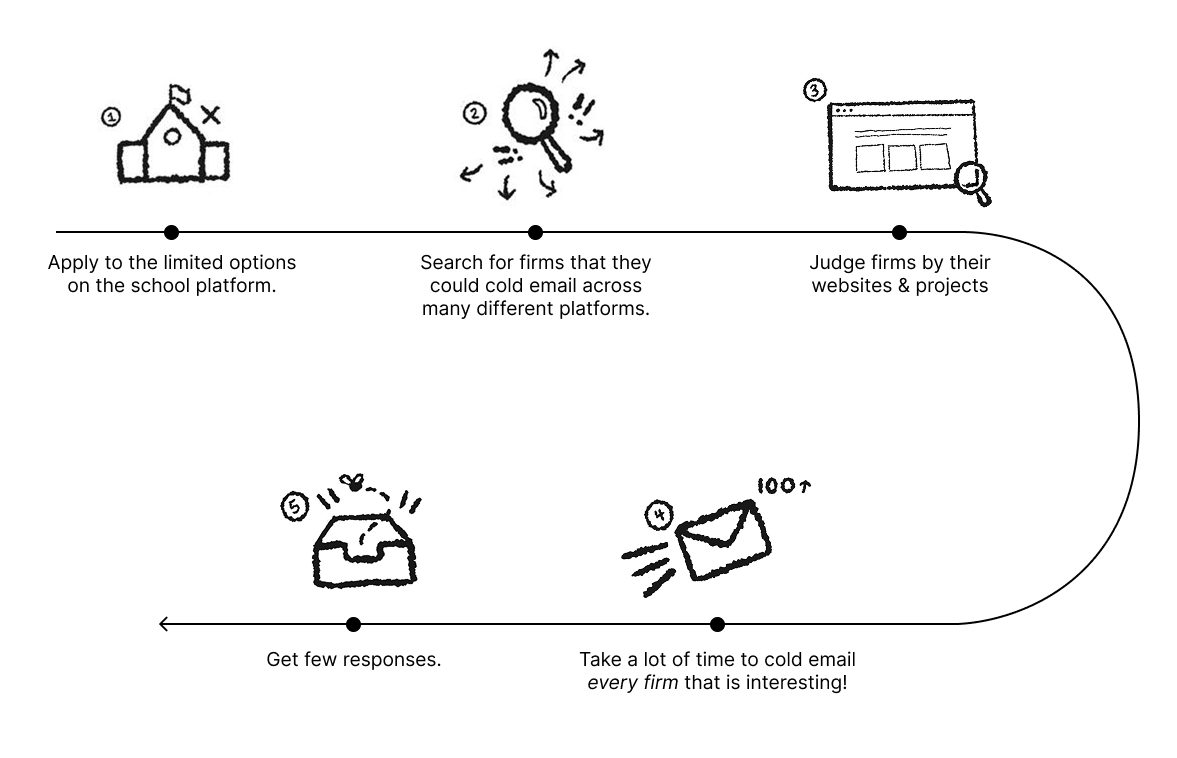
The internship application process for architecture students often does not rely on traditional job application platforms, like Indeed or LinkedIn, but instead on searching for firms to apply to across several platforms and cold emailing by volume.
This is because, especially international and smaller firms, do not create job postings and accept candidates from cold emails.
USER PERSONA
Students have shifting internship needs.
When interviewing users, it was discovered that when they had no experience, they were open to any opportunities.
As students gained more work experience, they were more selective about aspects like location and what gaps in skills they could fill by choosing certain internships.
Searching Sarah (0 internships completed)
2nd YEAR UNDERGRADUATE ARCHITECTURE STUDENT | NEVER LIVED AWAY FROM HOME
Goals
Learn what it is like to work in an architecture office for the first time
Fulfill the necessary co-op credit for her school
Frustrations
Nervous firms are less likely to accept her application
Does not know many upper year classmates to ask for advice from
Scared about potentially moving away from home
Searching Sarah (3 internships completed)
4th YEAR UNDERGRADUATE ARCHITECTURE STUDENT | WORKED IN 3 DIFFERENT CITIES
Goals
Find a firm she would want to work for post-graduation
Gain experience on the construction documentation phase and with Revit
Work at a firm in her home city
Frustrations
Wants to avoid excessive overtime based on previous internship experiences
Having to search across many platforms to find firms to apply to
Getting ghosted by many firms because she is emailing en masse
PRIORITIZATION
What is key to have in the final prototype?
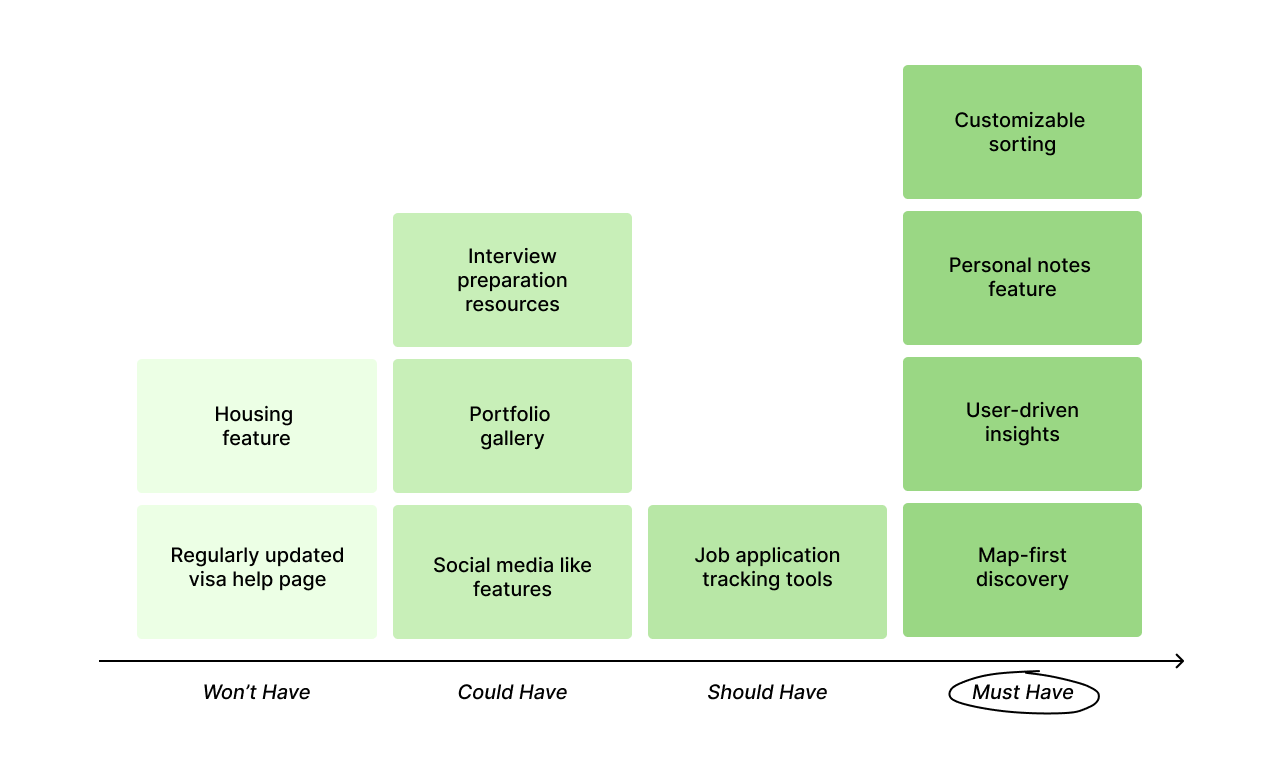
After interviewing users, I brainstormed possible features to help with every possible frustration that users had mentioned. However, I quickly found that there were too many features and features that did not address the main problem at hand.
In order to avoid scope creep, I organized these features by using the MoSCoW prioritization technique. For the sake of this project, I focused on the "must-haves".
USER TASK FLOW
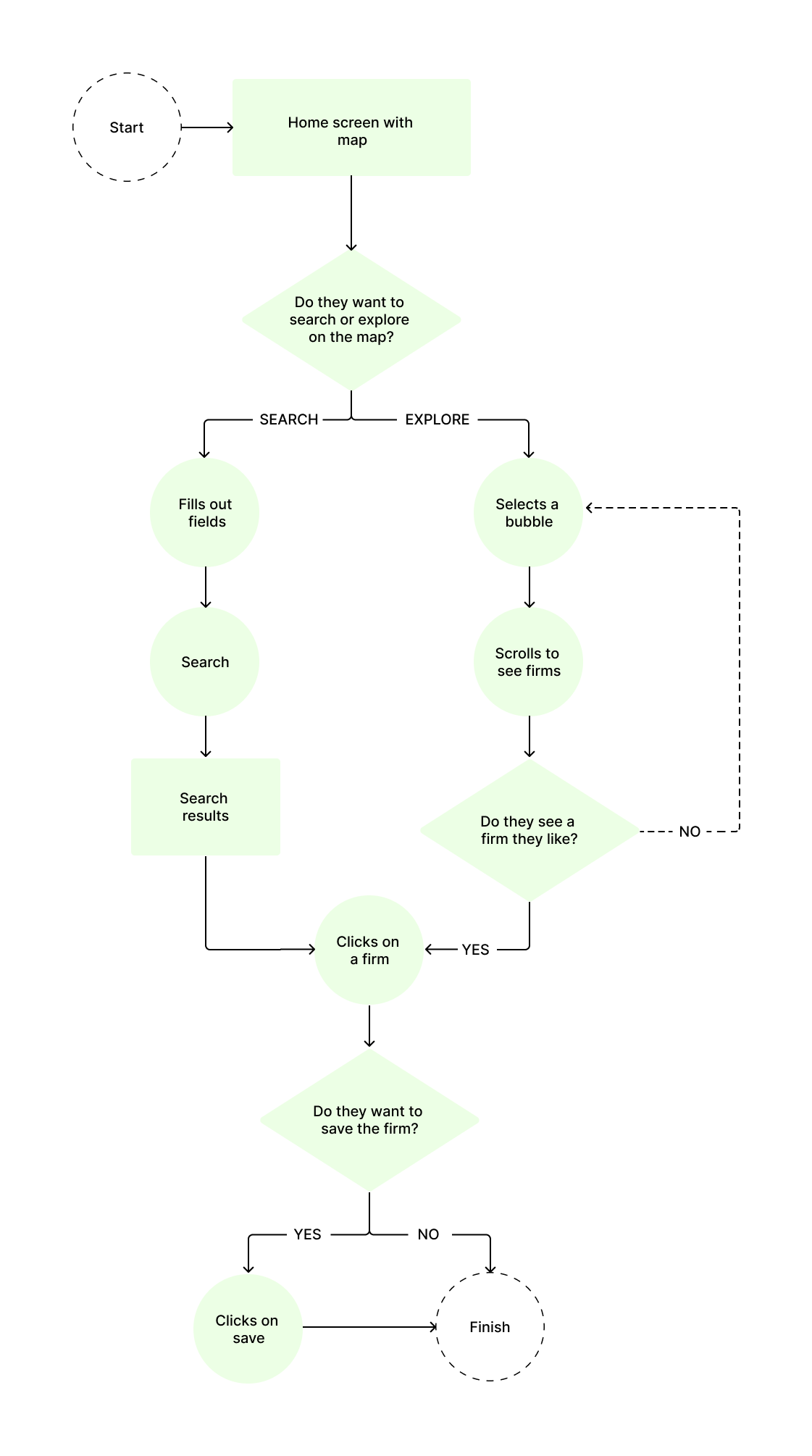
What are different ways students might search for firms?
As the information that students need to make an informed decision shifts, the platform was designed for different types of searching needs that different students would have. With this in mind, platform was designed with different searching pathways.
MID-FIDELITY WIREFRAMES
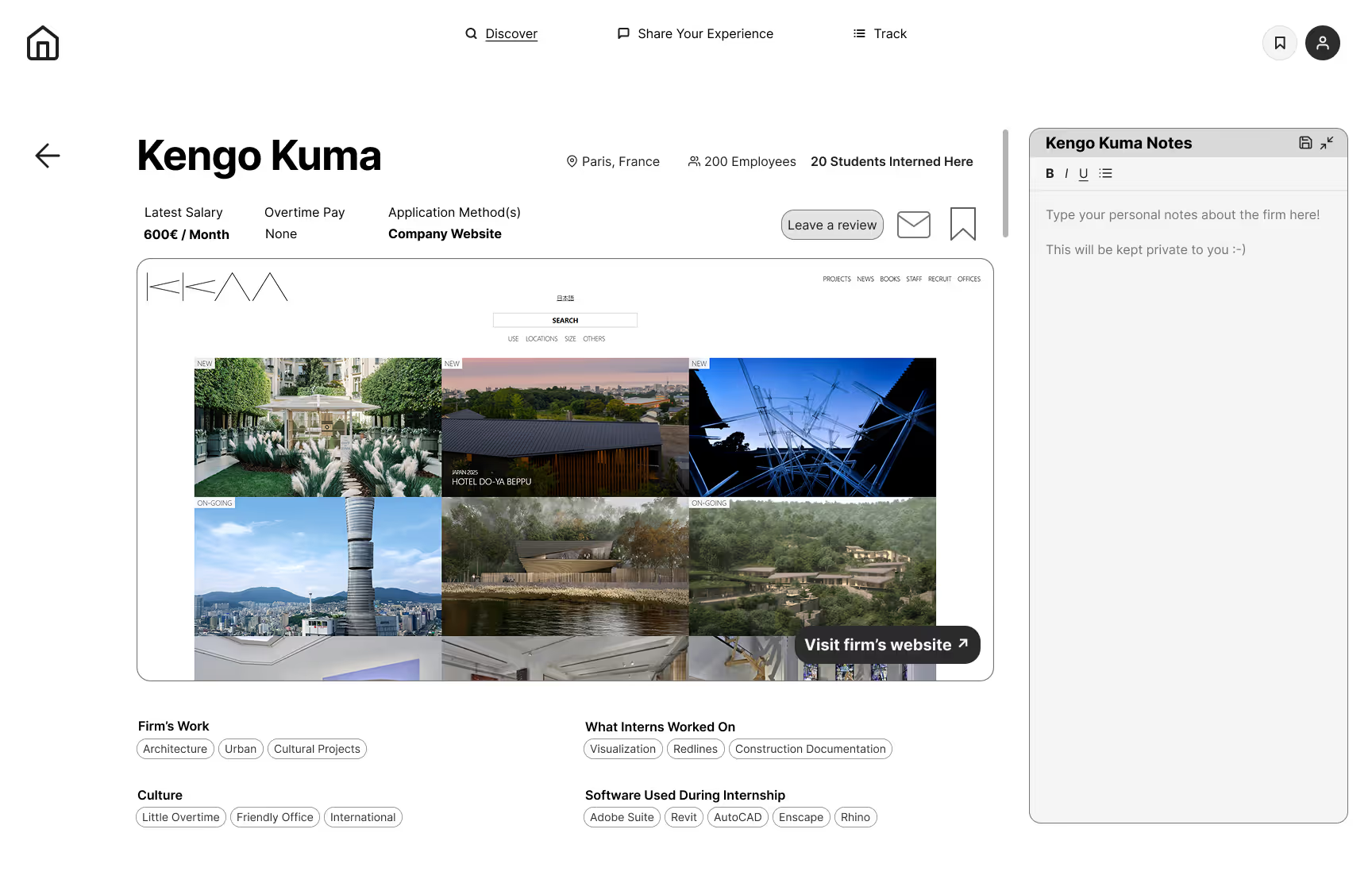
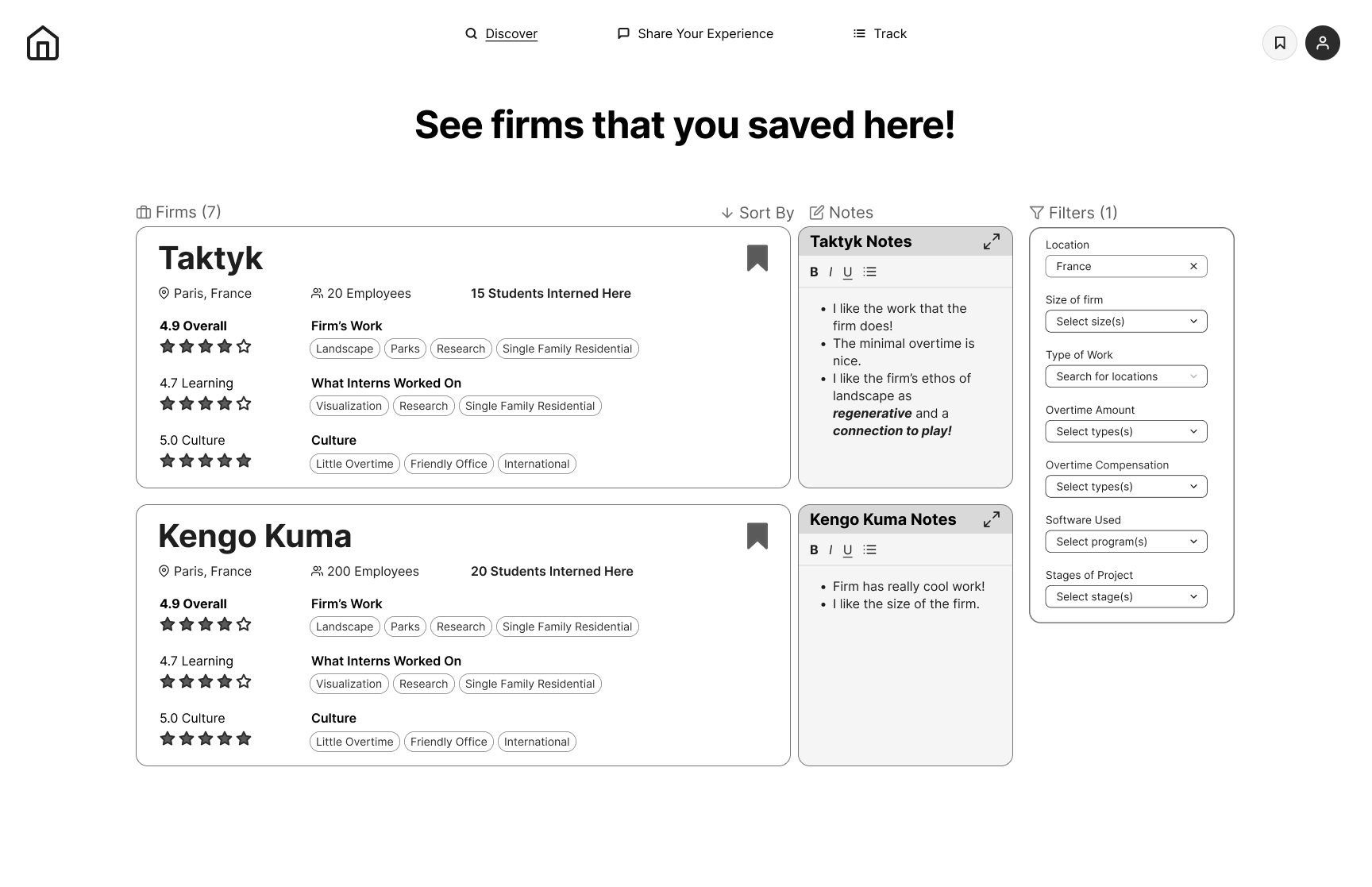
From the ideation, the mid-fidelity wireframes were created.
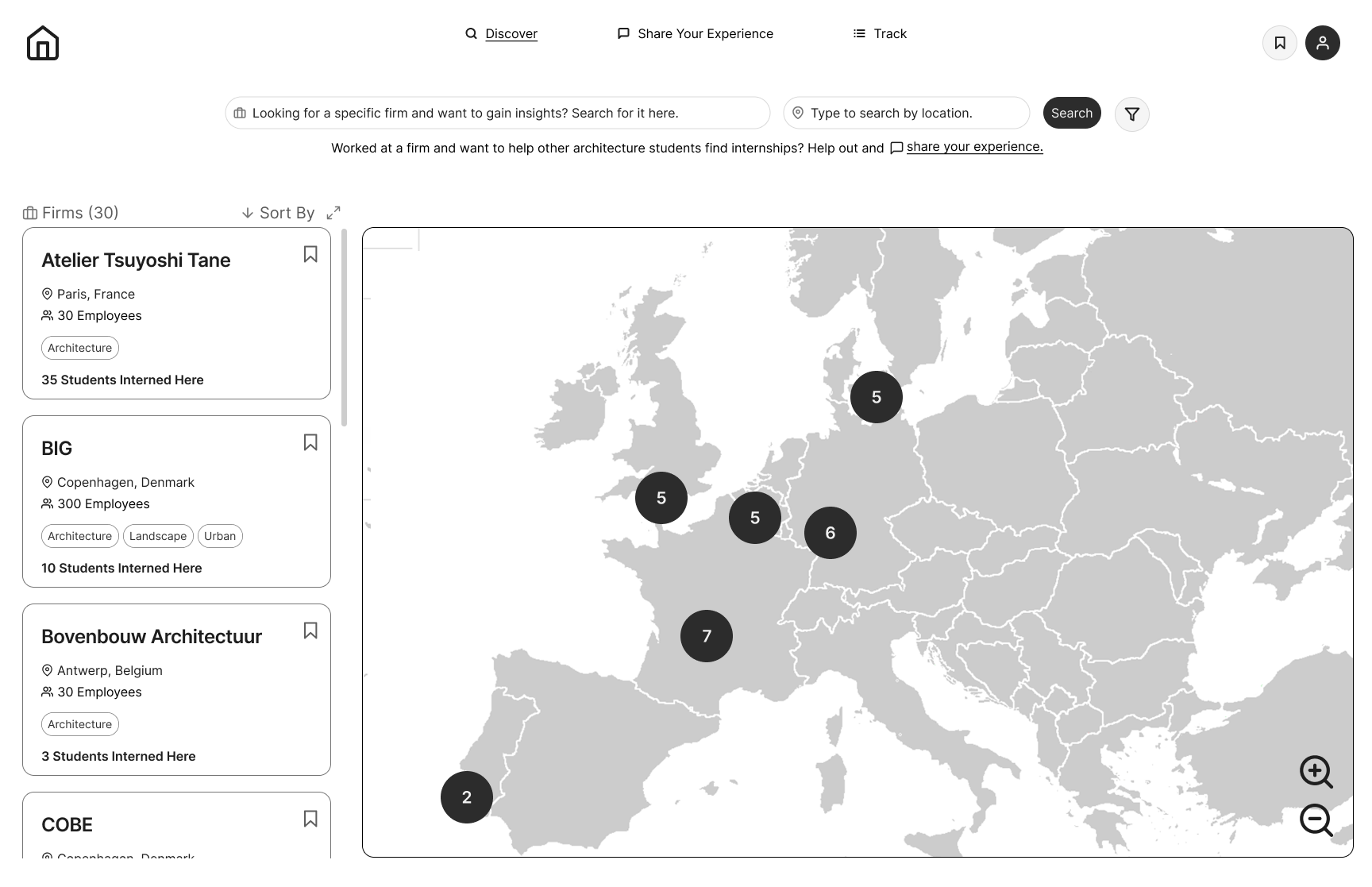
The following screens were created for a user who was just exploring the map and for an example user specifically looking to complete an internship in Paris with little overtime.
USER TESTING & FINAL PROTOTYPE
I conducted 5 user tests to get feedback to inform the final prototype.
To check if the solution was understandable to users, I created three different searching tasks to test if the prototype was intuitive to users.
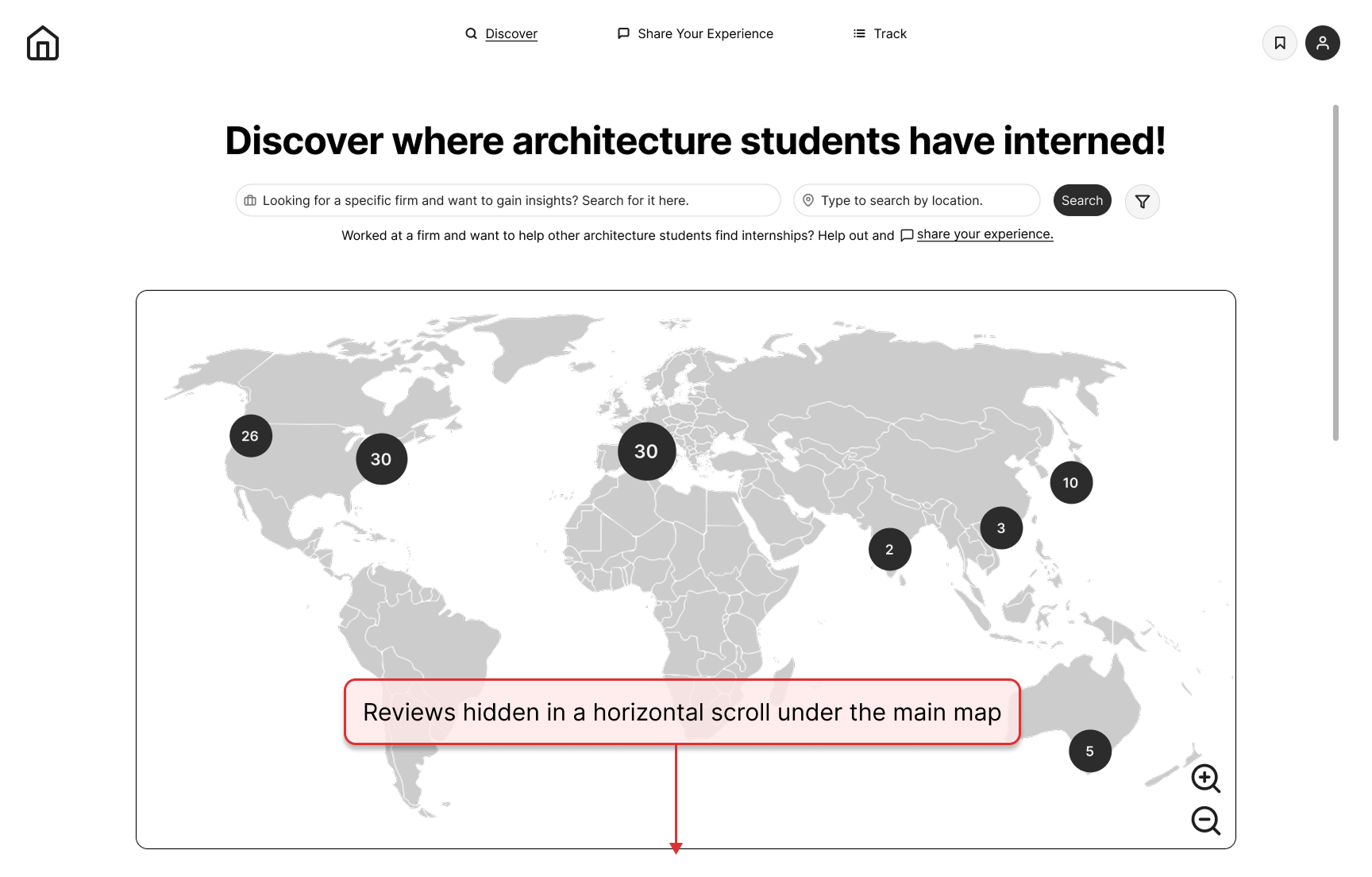
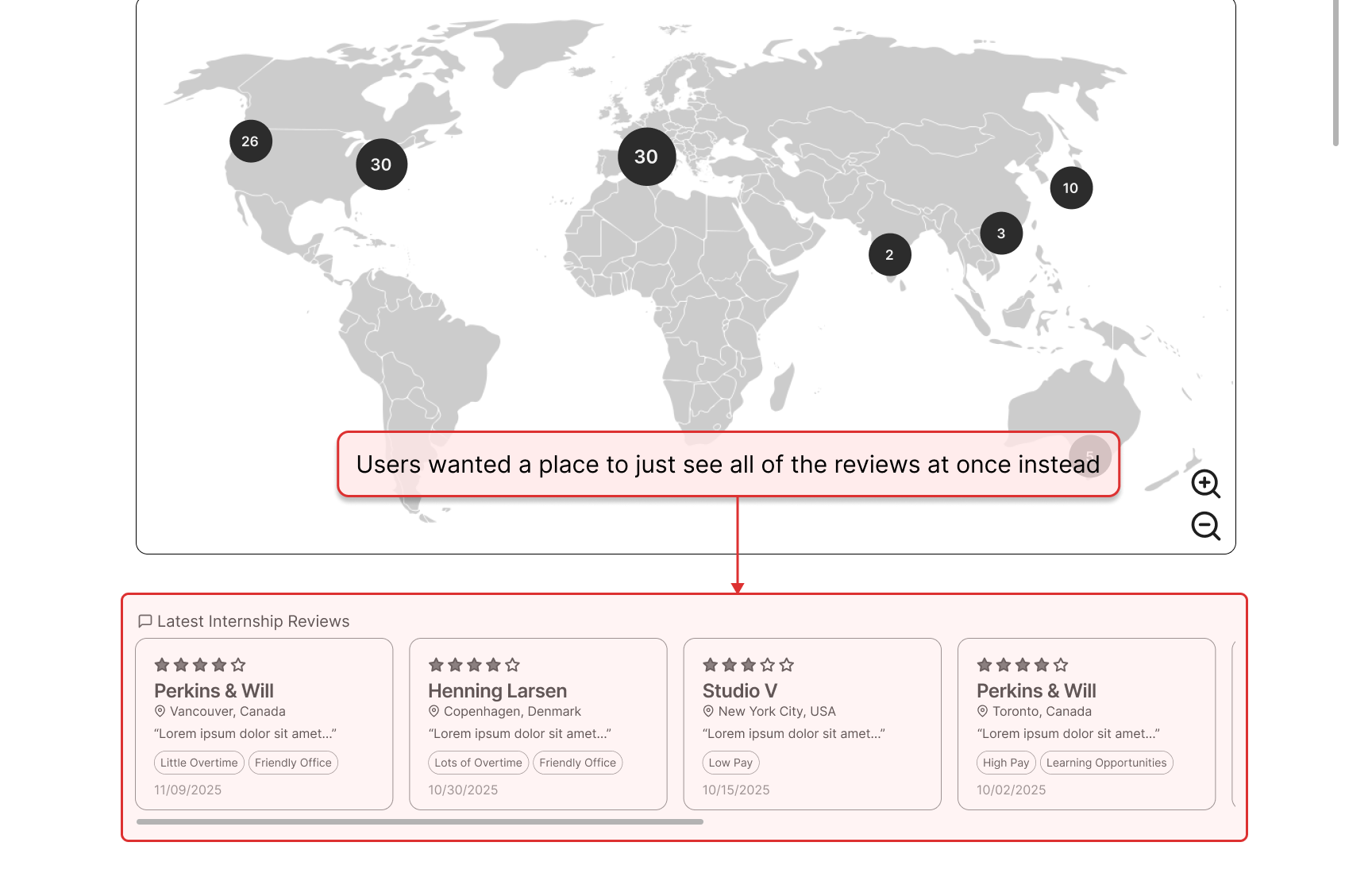
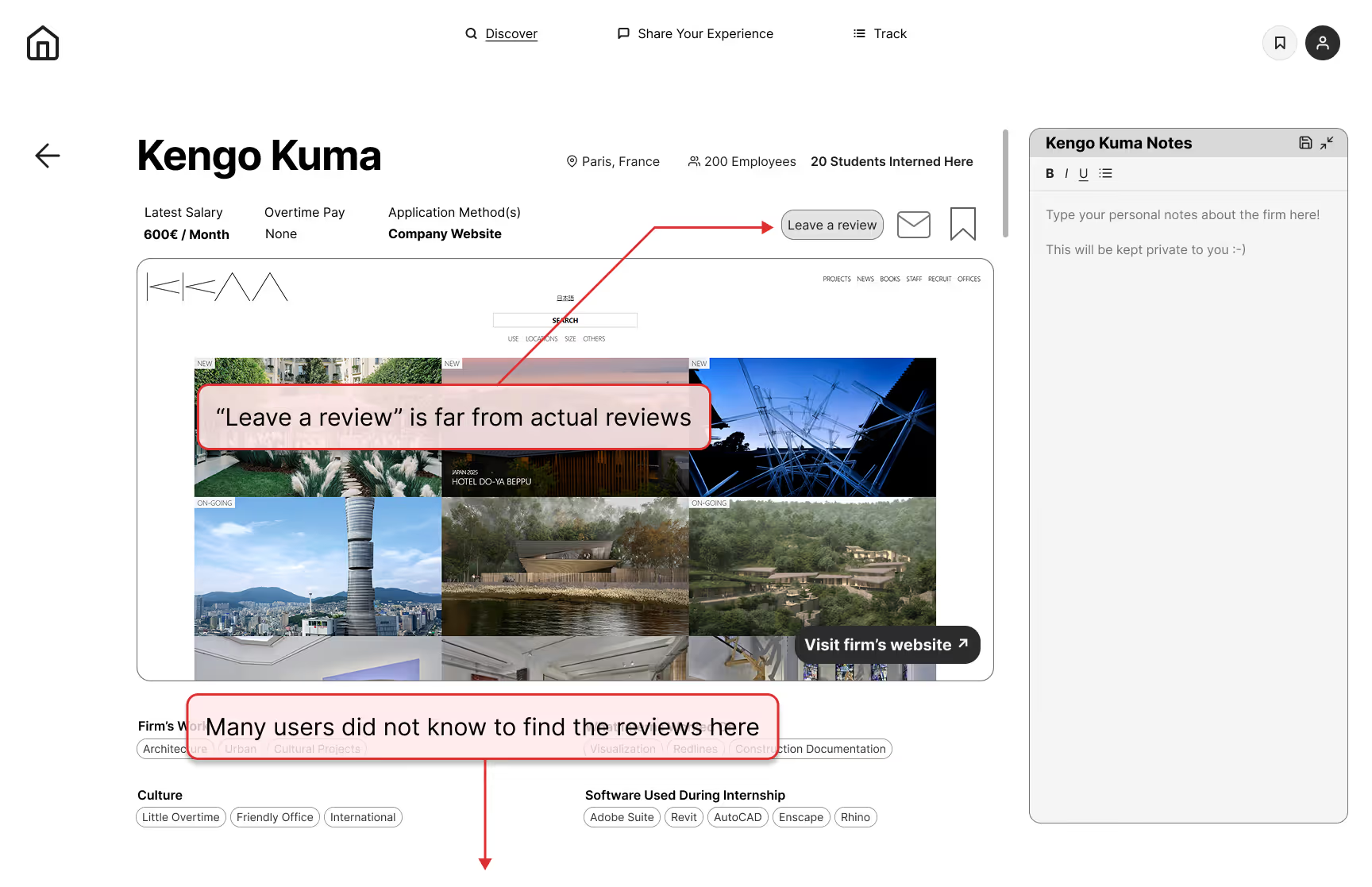
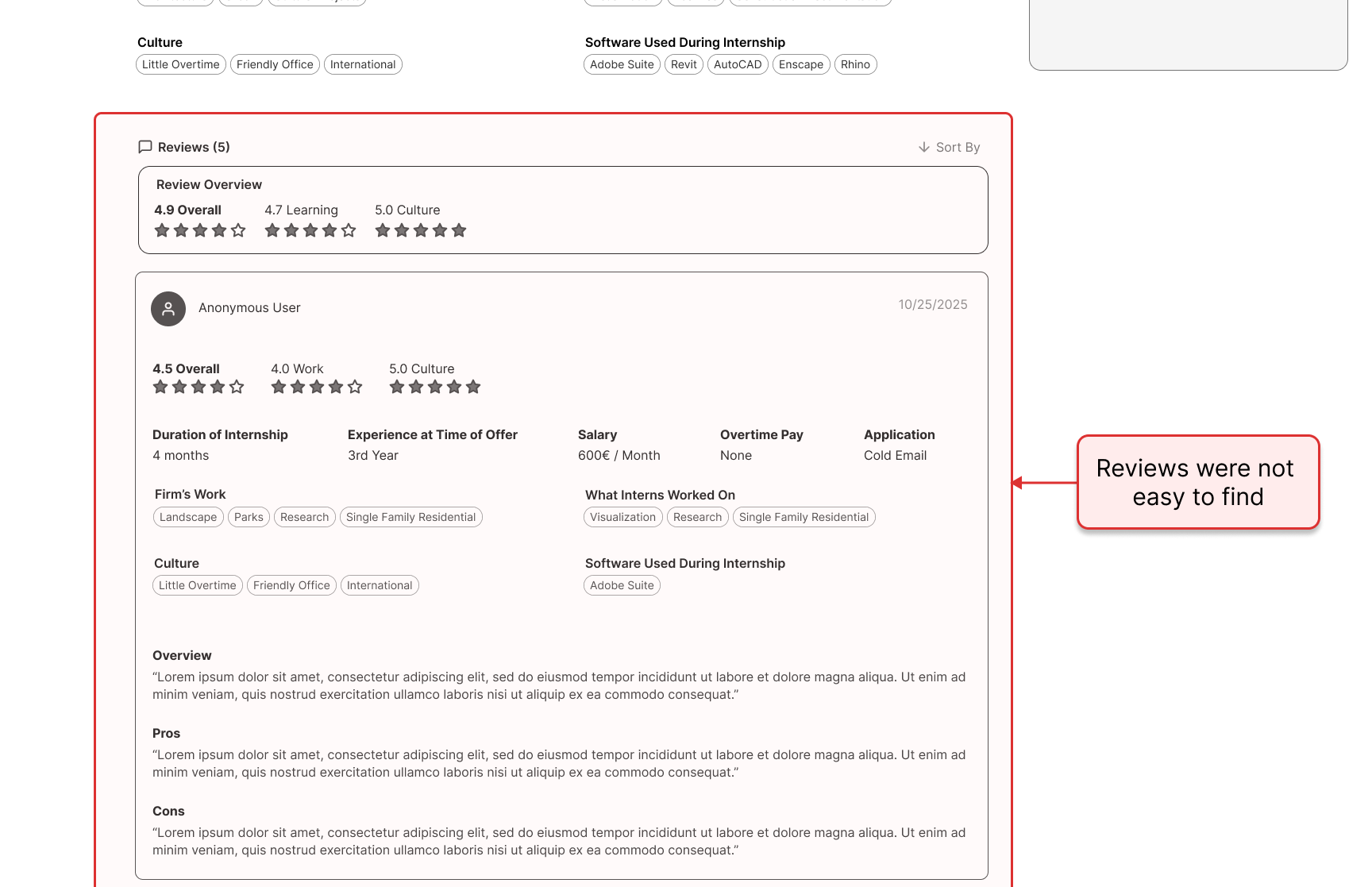
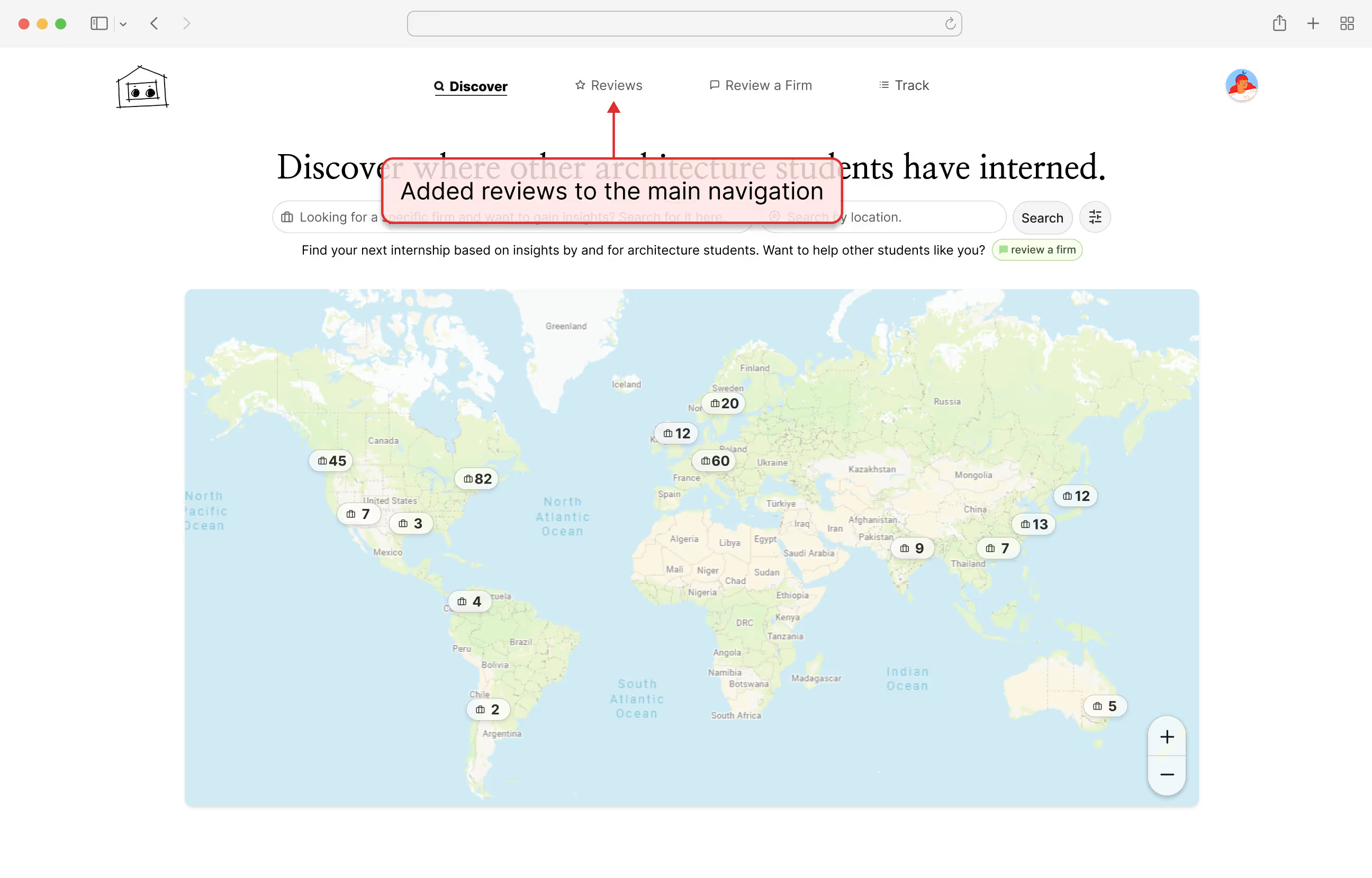
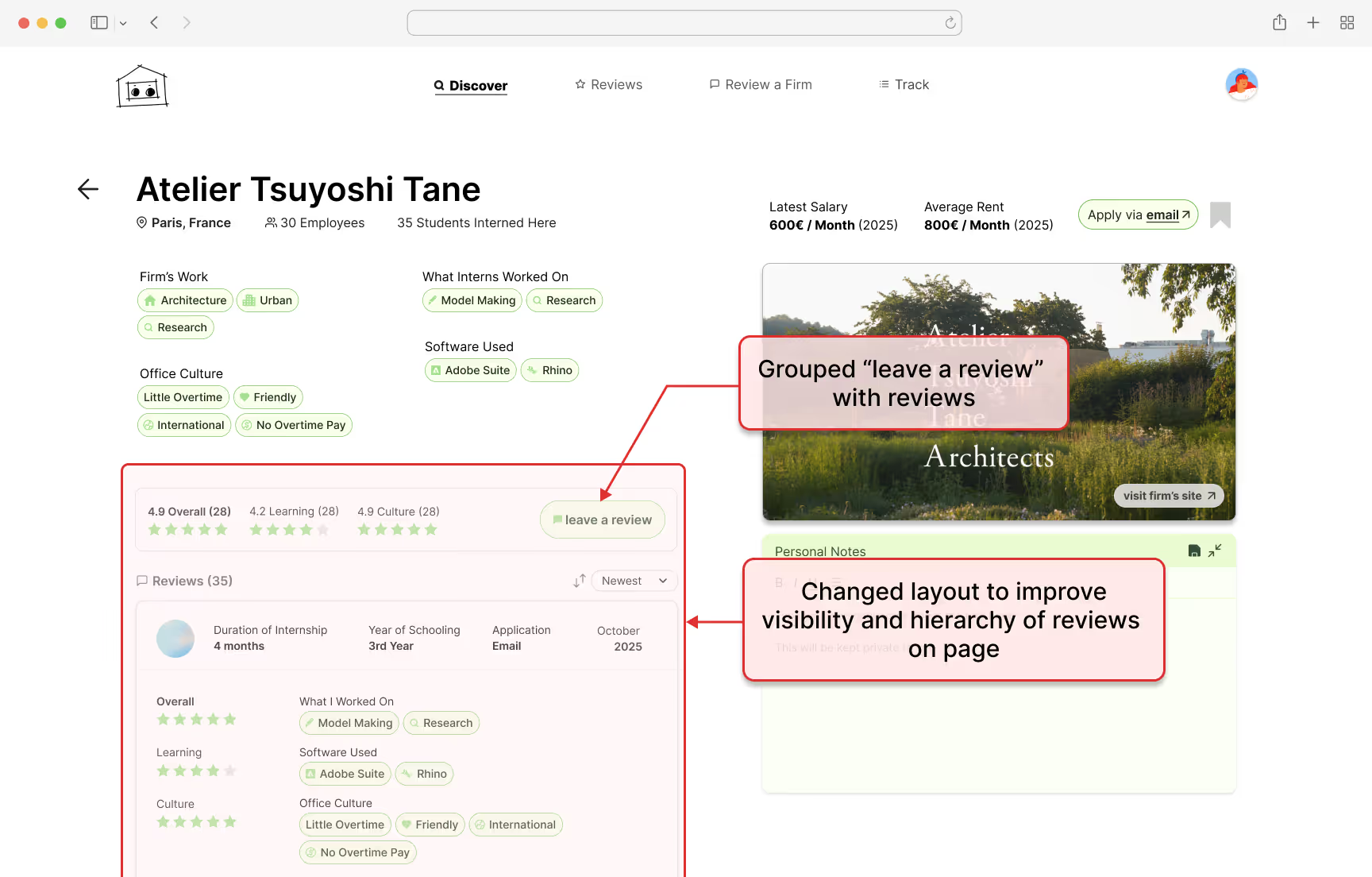
1. Improving discoverability
While reviews were central to providing insights to architecture students, users often found them hard to find. The navigation and information hierarchy on the pages were improved to highlight the reviews.
MID-FIDELITY WIREFRAMES
FINAL PROTOTYPE
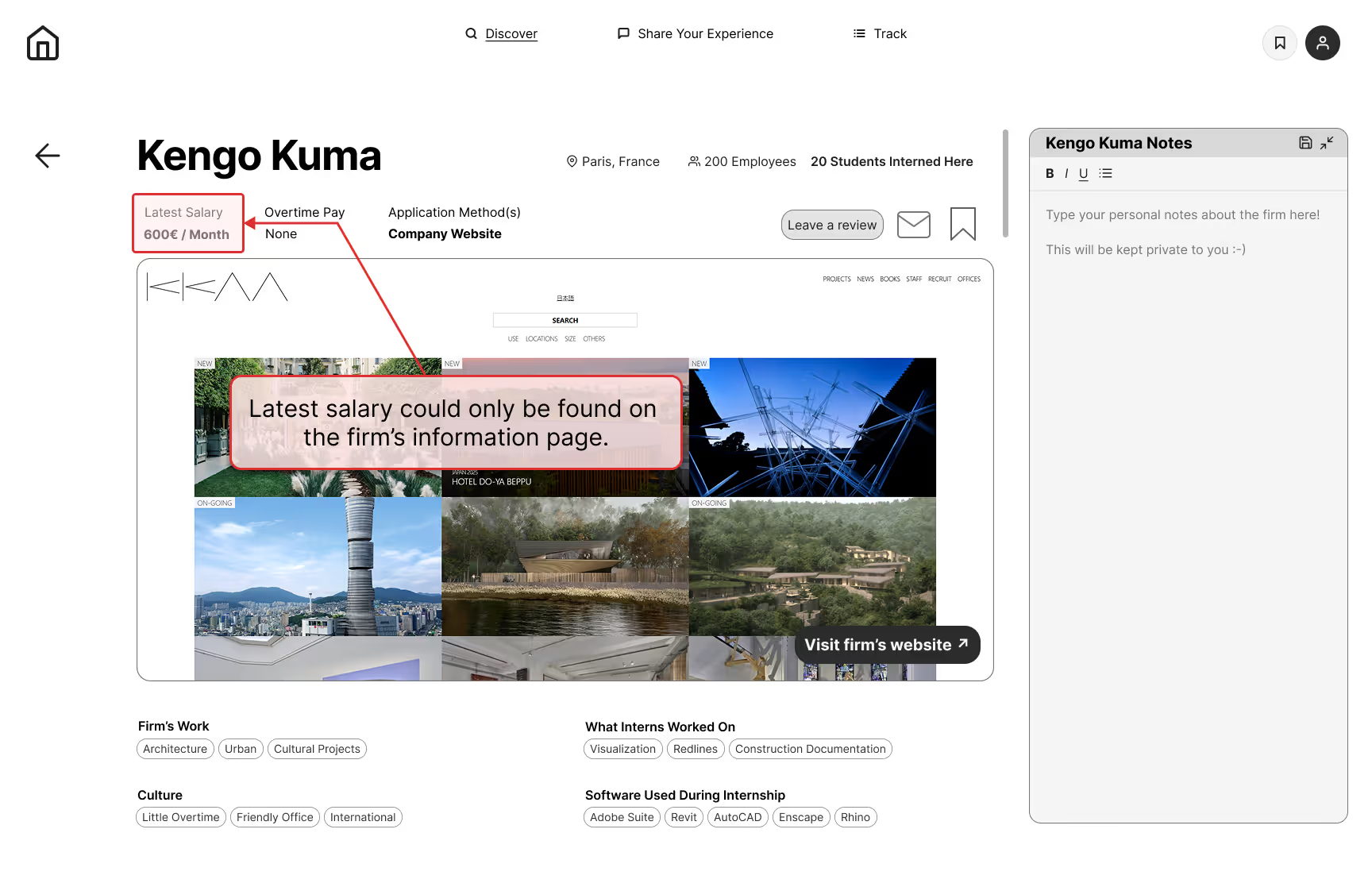
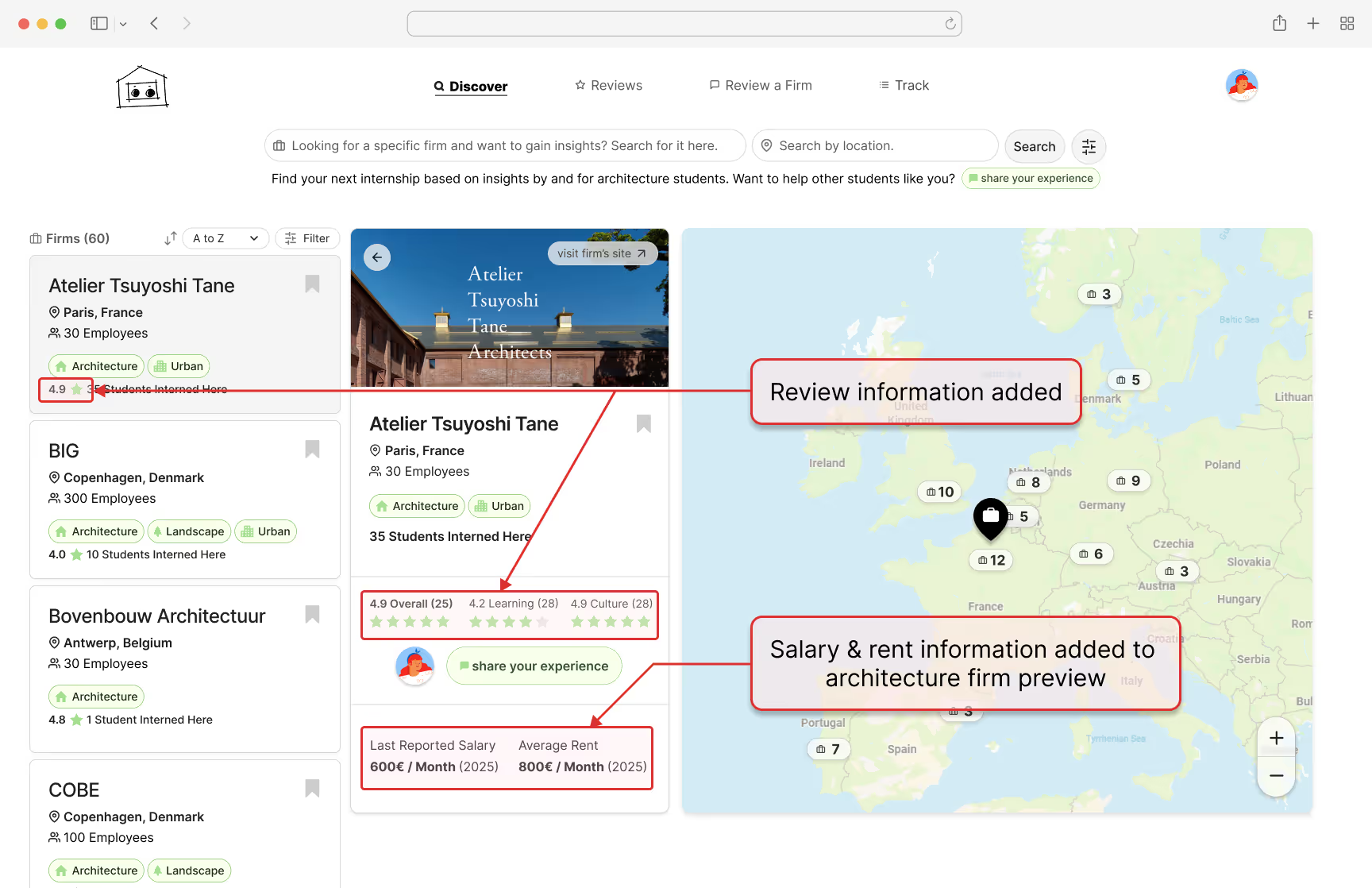
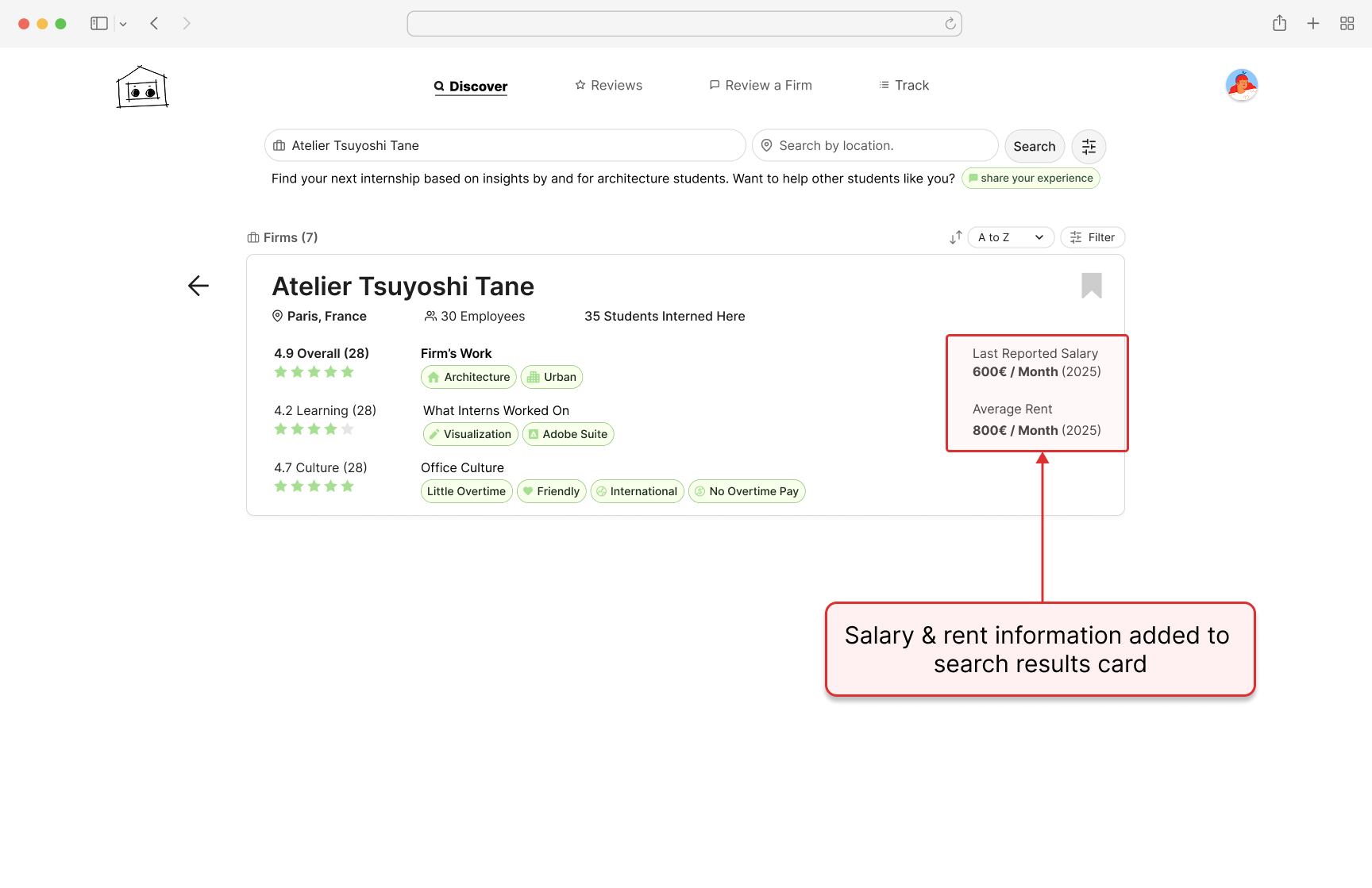
2. Changing User Priorities
During user interviews, when asked about pay, users mentioned that it was not the most important aspect of an internship to them. However, during user testing, most of the users upon seeing pay information wanted to see it quicker and in relation to what the cost of living was for that city.
Upon seeing the review feature in the prototypes, users also stressed the importance of this information.
MID-FIDELITY WIREFRAMES
FINAL PROTOTYPE
NEXT STEPS
What can be done next?
Broadening User Insights
For the project, I interviewed my peers from my undergraduate architecture program because I felt comfortable doing so. However, all my peers experienced the same undergraduate architecture program.
In order to gain more insights that were not captured from this limited user pool, I could distribute surveys in online architecture spaces and reach out to peers that attended different institutions.
FUTURE FEATURES
How can the Architecture Internship Finder grow?
Expanding Job Tracking
When users were asked about tracking their job applications during user interview, the answers ranged from sometimes using tools like Microsoft Excel to not finding tracking helpful at all.
However, in user testing, users mentioned that with the save feature in the website, they would love to be able to use the website to track their applications instead of their other tools.
Creating School Partnerships
Completing architecture internships is critical for students to understand skills necessary for working in the industry that are not taught in school, so many architecture universities have internship programs.
To expand the tool's user base, I would want to create relationships with architecture institutions globally to offer this tool to their students.
TAKEAWAYS
What did I learn? ⋆˚꩜。
How to Define a Project's Scope
While ideating, I found it was easy to create many features that I thought would help my target user base. This quickly made the project too complicated for my available time and resources.
Using different prioritization matrices and rooting the solution in user insights, I was able to narrow my scope to what was most important for the final prototype.
Self-Direction & Balancing Workloads
I completed this project on my own during my first semester of graduate schooling in a field new to me. This project was born out of my frustrations from applying to architecture internships, but also because I want to grow as a product designer! The product design field is new and exciting to me, so I want to learn and push myself as much as I can.
While managing tight deadlines at school, I set out and completed self-structured goals and deadlines.












.jpeg)
.png)
.png)









.jpeg)